Showing posts with label ghc10_bj. Show all posts

Wednesday, October 13, 2010

After the Grace Hopper Conference: There's More!

Thank you so much to everyone who contributed to the success of the 10th Grace Hopper Celebration of Women in Computing! Whether or not you attended, you can benefit from the event and help us make the next even better.

Your Feedback is Important
If you attended the conference please complete the GHC10 evaluation survey. The survey data will be independently reviewed and analyzed, then used both to report on the impact of this year's event and to improve future conferences. If you can't find the email with the evaluation link, look for a reminder from ABI's Caroline Simard early next week.

Session Notes, Slides, Blog Posts
Our speakers, volunteers, and many attendees have been posting their notes, slides, supplementary materials and links to related blog posts on our GHC10 notes wiki. If you presented, blogged about or took notes at GHC10, add your content or links to the wiki, too.

Photos and Videos:
Stay Connected
Don't lose that great feeling of GHC community! Stay connected with the Grace Hopper Celebration Community through your Poken connections, Facebook, LinkedIn, Twitter, Systers and more. Get connected with the parent Anita Borg Institute Community for year round updates on ABI programs, research, and awards.

Save the Dates!
Mark your calendar for the Grace Hopper Celebration, November 8-12, 2011 in Portland, Oregon. Subscribe to the ABI e-newsletter to make sure you don't miss the Call for Participation, scholarship application deadlines and more.

Friday, August 6, 2010

Meet the GHC10 Communities Committee!

For months the Grace Hopper 2010 Communities Committee worked behind the scenes. They created Twitter hashtags for GHC tracks, designed GHC speaker badges, determined community volunteer needs, and planned topics.

In the last few weeks they've become more visible as GHC community evangelists. Across our GHC online communities on Facebook, LinkedIn, Twitter, Flickr, and the GHC Blog they're starting conversations, sharing introductions and favorite GHC memories, and inviting participation by community members.

Many of our hard-working Grace Hopper committees complete their tasks well before the conference: selecting program submissions and scholarship recipients, recommending speakers, and deciding on award winners. Not so for this committee, which is a new addition this year. They'll Keep working right through Grace Hopper to help you connect online before, during and (if I know them) even after the conference. So here's a quick introduction to the committee members:

screenshot from Introducing a Recent Undergraduate post on the GHC blogCo-Chair Ashley Myers just completed her undergraduate CS degree at DePauw University and will start at Microsoft later this month. She helps with the @ghc Twitter account and will co-moderate the Grace Hopper Celebrat­ion 2010 group on YouTube. Learn more about Ashley on the GHC blog in her post Introducing a Recent Undergrad Graduate.


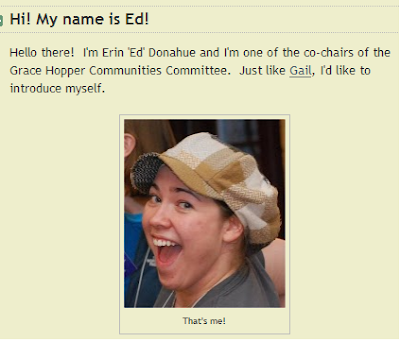
screenshot from Hi My name is Ed post on the GHC Blog
Co-Chair Erin ‘Ed’ Donahue also started coming to GHC as a DePauw student and now works at Lockheed Martin, a career connection she made at the 2008 conference. Learn more about Ed in her blog post Hi! My name is Ed!

With Ashley, Ed helps with the @ghc account and will co-moderate the YouTube group. They also host Ed & Ashley's 5 Minute Show, featuring interviews with technical women interviewed at GHC and other events.
Gail Carmichael is a doctoral candidate at Carleton University. Gail is the lead for our GHC bloggers and note-takers again this year, and also taking a leadership role on the GHC10 group on Flickr. Learn more about Gail on the GHC blog and check out her blog The Female Perspective of Computer Science.
screenshot with link to Twitter post of a favorite GHC memoryKate Tsoukalas is a graduate of Simon Fraser University and now works at Microsoft. Kate helps moderate the Grace Hopper Celebration page on Facebook. Join Kate in Discussions on the Grace Hopper Celebration page on Facebook (requires login).
Valerie Bubb Fenwick is a Principal Software Engineer at Oracle, arriving through the Sun acquisition. Valerie helps manage the Anita Borg Institute and Grace Hopper Celebration groups on LinkedIn. Learn more about Valerie in the Introduce Yourself! discussion on LinkedIn or Facebook.

And watch for upcoming blog posts from committee members on how to make the best use of each GHC online community. Meanwhile:
  • If you're coming to the conference, introduce yourself to the community.
  • If you've attended Grace Hopper before, share your favorite memory.
  • Follow @ghc/communities-committee to connect with these evangelists on Twitter.
  • Sign up for the ghc10-attendees Twitter list when you register for GHC10.
Come join the discussion here or on Facebook, LinkedIn or Twitter!

Tuesday, July 6, 2010

3 Women, 2 Grace Hopper Conferences, 1 Global Collaboration

Three of the memorable women I talked with at Grace Hopper (GHC) in 2009 were Shikoh Gitau, a student researcher from South Africa, and Mary Hudachek-Buswell and Stefanie Markham, the local chairs for this year’s conference in Atlanta. These women forged a strong connection at GHC 2009 that has continued to develop, resulting in a panel to be presented at GHC 2010. Earlier this year Mary shared how she and Shikoh first connected: through our Grace Hopper 2009 Rides & Roommates discussion on Facebook. It’s such a great Grace Hopper story that I asked them to share it here on the GHC blog.

Mary’s story: Meeting Shikoh at GHC09

Last year was my first time to experience the inspiration of GHC. It was a long anticipated trip since GHC has always been something I wanted to participate in, but had not had the opportunity to do so in the past. I was asked to serve as the local chair for GHC10, and I just had to get to Tucson for GHC09. I decided to immerse myself in the experience of attending before traveling by reading the posts on Facebook and LinkedIn as the time approached. In order to save travel money with the budget crunch, I had to fly into Phoenix and drive to Tucson in a rental car. I kept noticing people posting requests for rides, meetings, or attending some sightseeing events together. I thought it was a great idea to communicate in this way. I liken it to listening in on a huge girls' gab session where they were all discussing going to THE party of the year. I became slightly addicted to reading the blogs, posts, and tweets which fed my excitement in attending GHC09. Occasionally, the thought would enter my mind, "What if GHC didn't measure up to my hopes and vision that I built up in mind?"

I was going to GHC09 with my Computer Science "sister", Stefanie Markham. As the time approached and anticipation mounted, I took the plunge and began participating in the online conversations. There was a post from a young woman in Cape Town, South Africa who needed a ride to Tucson from the Phoenix airport the day before the conference started. I had space in the car with only Stef and me driving down from Phoenix, so why not? It was the day and time we were arriving, and it would only cost sharing a couple of hours with a stranger in a small car in the middle of the desert. So Shikoh Gitau and I began coordinating online how we would meet, since phoning was out of the question. I gave Shikoh my cell number to call the day I would arrive in Phoenix. That was how we left it. Would she actually be there from South Africa? What did she really know about me? We each gave a leap of faith based on our common bond for what GHC could hold for both us.

Stef and I landed in Phoenix, finally got our bags, located the rental car facility, and finally got the car (seemed like hours). All the while playing phone tag with Shikoh. What Shikoh must have thought of the two crazy women from Atlanta. We met in an underground parking lot in Phoenix on what seemed like the hottest day of the year. As we began our drive to Tucson, (yes there were wrong turns as I was the driver) we got to know about each other and how our paths led us to GHC09. Shikoh had the same spirit as Stef and me, and a passion for furthering women in computing. Our new acquaintance with each other was fast growing into a tentative friendship as we filled every minute of the two hour drive with giddy discussion. We arrived at the resort and Shikoh determined she needed to be at a hotel somewhere else in downtown Tucson and there were no shuttles to get her there. Stef and I quickly checked into our room, and then headed out to take Shikoh to her hotel at the University of Arizona, as wel as a couple of other stranded students. Stefanie and I dropped the young women off, and then headed out to explore Arizona after a stop for fast food. We thought this would be our last encounter with Shikoh.

Not so! First thing the next morning and throughout the week, I continued to run into Shikoh and we would share our viewpoints, ideas, and information from sessions. We talked about how we should do something together for a future GHC. As we discussed the important issue of gender based violence after Megan Smith's speech, an idea came to the forefront of what we might be able to do. It was one of those goosebump moments in your life where you realize you might actually be able to make a real change in the world for the greater good. Our idea continued to grow, and plans were sketched out before we departed for our separate parts of the world. Both of us were forever changed by our meeting and connection to GHC. We have communicated electronically over the last 8 months, and our panel Take Back the Tech (Part II) was accepted to GHC10. We have a dream to harness technology in order to end violence against women in third world countries.

Shikoh’s story: Meeting Mary and Stef at GHC09

After receiving the news that my poster had been accepted for the GHC and that I had a travel scholarship to go all the way to Arizona, I was ecstatic. After all the excitement cooled down, I got right into planning how I was going to get myself SAFELY to Tucson. The Cape Town – Arizona flight takes about 24hours, so to beat the 11 hour jetlag I planned to arrive a day early. However, my funding did not cover the extra night so I first scanned my over 800 Facebook friends list to see who among my former classmates and friends lived in the area. The nearest I got was Phoenix, Arizona. They were very kind to host me for the one night. The next problem I encountered was to get to the hotel in Tucson from Phoenix. I joined the GHC fan page to see who was doing what, and posted my need for a ride to Tucson. Being from Africa, I am very wary of this kind of arrangement, Hollywood does not instill much confidence in as far as the great American desert is concerned. I had seen all sorts of imposter and hijacking movies, but I cast away the fears and went to the underground parking lot of the Phoenix Airport. With no pictures to view, I had to work with clothing color in order to identify Mary and Stef.

The U.S. was very new to me, so they brought me up to date with the whole being an American ritual. In that drive, I gained good friends and mentors as we headed towards GHC09 in what I regard as the greatest gathering on earth. Previous to the trip, I read a lot of what was presented in GHC, and came away feeling like an odd ball. My research in computer science was totally different from anything anyone was presenting, and needless to say I felt like an imposter. So as we exchanged our research approaches, I ended mine by saying that I am not “a real computer scientist”. The reaction from both Mary and Stef was not what I expected. They in unison told me to never ever say that, and stated that my research was great. It was good that I met these women and they had told me my work was good, because in the coming days, I continued to experience the “I am not a real computer scientist” thing, and they were there to correct me at every turn. After the keynote speech by Megan Smith (Google), they both came hunting after me with an “I told you so” expression written all over their faces. I have to say they were right; my research is indeed real computer science research. The meeting and discussion thereafter lead to the organization of Take Back the Tech (Part II), a panel at GHC10 that will bring together women from industry, academia, women’s rights activist as well as feminist organizations to discuss technology and gender based violence. We hope to have a concrete technological intervention as result of this panel as well as the continuing conversation.


Join Shikoh and Mary in the Grace Hopper Celebration session Take Back the Tech (Part II): A Feminist and Techie Dialogue on taking control of technology to end violence against women from 4:15 p.m. – 5:15 p.m. on Friday, October 1, 2010.

If you seek a ride or roommate for GHC, look for Grace Hopper 2010 Rides & Roommates on the Discussions tab of our Facebook page. And make your own pre-conference connections through our GHC online communities.

Do you have a story of a great connection made at the Grace Hopper Celebration? Tell us about it!

Tuesday, June 15, 2010

All Atwitter About the Grace Hopper Celebration!

Each year more and more Grace Hopper Celebration (GHC) attendees are using Twitter. This year we're using the hashtag #ghc10 to identify tweets (Twitter updates) related to the GHC 2010 conference. And we're taking advantage of a new Twitter feature: lists that help you connect with other participants before, during and after the conference.

When you register for the conference, you'll be given the option to add your Twitter name to our list of GHC10 attendees and, if you're presenting, to our list of GHC10 speakers. This will make it easier for presenters and attendees to connect through Twitter. It also makes it easier for the GHC Twitter account (@ghc) to follow you and assist with questions about the conference.

Here's how to make the most of Twitter for GHC 2010:
  • Follow @ghc for Grace Hopper Celebration updates on Twitter.
  • Start your tweet with "@ghc" to address a comment (suggestion: introduce yourself!) or question to the GHC twitterer.
  • Find out what others are saying about the conference using our hashtag #ghc10
  • Join in by including the #ghc10 hashtag in your conference-related tweets.
  • When you register for the conference, add your Twitter name to our list of GHC10 attendees and, if you're presenting, to our list of GHC10 speakers.
  • Complete your Twitter profile with a picture, bio, and link to your website or blog so other participants can tell who you are.
Remember that if your profile is protected, others will not be able to view your tweets by search or through the lists unless they go through the process of getting your permission.

If you've wondered who is behind all those @ghc tweets, our primary twitterer is BJ Wishinsky, Communities Program Manager at the Anita Borg Institute for Women and Technology (ABI). Assisting from time to time are other ABI staff and, as we get closer to the conference, volunteers from our GHC 2010 Communities Committee. Watch for more information on the committee in an upcoming newsletter.

For those not yet familiar with Twitter, here’s a short video by Common Craft to explain the concept: Twitter in Plain English.


This was cross-posted as an article on http://gracehopper.org/

Saturday, March 20, 2010

Apply for a scholarship to attend the Grace Hopper 2010 Conference!

In case you missed the press release, applications are now open for the 2010 Grace Hopper Celebration (GHC). GHC scholarships cover a combination of registration, meals, lodging and a fixed amount of travel expenses. The deadline to apply for a scholarship to attend this year's conference is May 14th.

Here are a few things you may not know about GHC scholarships.
  • Last year, 311 Grace Hopper 2009 participants attended on scholarships.
  • Students are not the only participants who can receive GHC scholarships: Junior faculty and employees of nonprofits and NGOs are also eligible to apply.
  • Participating in the conference will increase your chances of getting a scholarship. Since some of the program submission deadlines have been extended, take this opportunity to submit a proposal. Deadlines are March 30th for PhD Forum and New Investigators; April 6th for Technical Poster.
For more information or to apply for a scholarship see
http://gracehopper.org/2010/participate/student-scholarships/

Monday, March 8, 2010

Who do you know that we can recognize through our GHC Awards?

by Telle Whitney, President & CEO, Anita Borg Institute for Women and Technology

Editor's Note: This was originally posted on the Anita Borg Institute blog. I'm cross-posting it here to help spread the word to our GHC community.

Some of the most important work we do at the Anita Borg Institute for Women and Technology is to recognize women who are changing the face of technology. Recognizing women role models is not only important for the award winner, but also for the millions of women who look up and say yes, I can have an impact too. As you read this, recognize that you know some extraordinary women who would be perfect candidates for our awards, and that I need your help.

Our awards recognize extraordinary people, whose work contributes to a changing perception of what it means to create and use technology. We need people who can nominate someone they admire. It doesn’t have to be you writing the nomination, but I bet you know someone who could put together a nomination.

Do you know a man or a woman academic under the age of 40, who has demonstrated leadership capability and who has had a positive impact on the lives of women through technology?

If so, consider nominating them for the Denice Denton Award., which includes a $5K award.

http://anitaborg.org/initiatives/awards/denice-denton-award/

Do you know an outstanding woman who is recognized world wide as a technical leader? Please consider nominating them for the Anita Borg Technical Leadership award, which includes a $10K award.

http://anitaborg.org/initiatives/awards/anita-borg-technical-leadership-award/

Do you know an individual or team who has caused technology to have a positive impact on the lives of women and society? Please consider nominating them for the Anita Borg Social Impact award, which includes a $10K award

http://anitaborg.org/initiatives/awards/anita-borg-social-impact-award/

Do you know technical women from developing countries, who are up-and-coming leaders that advance women’s participation in technology? If so, please consider nominating them for the Anita Borg Change Agent Awards

http://anitaborg.org/initiatives/awards/change-agent-awards/

All of these awards are given out at the Grace Hopper Conference Awards Ceremony, held on September 30, 2010 in Atlanta, Georgia. Nominations will be accepted until April 29th.

There is no more fulfilling work than nominating someone you admire, and knowing that you are having a positive impact on their life and the lives of technical women everywhere!!

Thursday, February 25, 2010

The Long and Short of Answering the Grace Hopper Call for Participation

You have a great idea for a Grace Hopper conference session. A really really great idea! In fact, as you prepare to submit your proposal, you realize that your idea may be TOO great. How in the world will you and your panelists cover everything that needs to be said in the space of a one hour session? It's just not going to fit! What do you do now? First, know that you're not alone. Others are facing the same problem as they work on their proposals. Others faced the same problem last year, and the year before. So I asked Deanna Kosaraju, the Anita Borg Institute's VP of Programs, what advice she has for those whose GHC ideas won't fit neatly into a one hour session.

Feeling the squeezeDeanna's top recommendation is that you really try to make the session fit into a single hour. Why? Because, based on prior GHC experience, Deanna expects there will be approximately ten times more conference submissions than there is physical space and time available at GHC 2010. In addition, the committees reviewing the program submissions will try to accept sessions from as many different presenters as possible. I'll offer some suggestions below for how to pare your session down. But here are your alternatives if feel you just can't make that work.

Can your idea be broken into two or more one-hour sessions? Divide them up with your collaborators and submit them (separately) as a mini-track. In the submission for each, describe how it is related to the other(s) and request that they be scheduled back-to-back (if that's necessary). But be forewarned: the committee may accept your multiple session proposals but only give you a single one-hour session to present them. This happened to me a few years ago when our two-panels-plus-one-BOF (Birds of a Feather) mini-track was accepted, but we were instructed to combine the two panels into one. We did, and used the BOF for the overflow conversation from the panel.

The other option is to include in your submission an explanation of how long the session should be. You will need to make a compelling case for why the session cannot be condensed into a single hour. You'll also need to show how the agenda will be broken up into chunks no longer than one hour, so that attendees will get regular breaks. Even if you do, the committee may accept your session proposal but only give you a single hour to present it. Deanna assured me this also has happened before.

Remember: The program committees will try to accept sessions from as many different presenters as possible. And they will receive many more great proposals than they can possibly fit into the available space and time. So let's go back to Deanna's original recommendation.

How do you condense a great session idea so it will fit into a single hour? Here are a few of my own suggestions, then I would love to hear yours:
  • One reason that sessions get too big for one hour is by having too many speakers. Limit the number of panelists you invite, so that each will have adequate time to share her contributions.
  • Select a subset of your topic to focus on. That might mean narrowing the problem space, e.g., focus on one special case or ignore special cases and focus on the general. It might mean selecting only the most important aspects of your topic, or perhaps the most popular (like a top ten list).
  • Move some of your content into a reference area in the back of your slides. You won't have time to present it but you can let attendees know it's there. Post your slides on the conference wiki for attendees to download. Or create an online resource area where attendees can go to find and/or share more ideas (this can also be done on the conference wiki).
Now let's hear from you. Have you streamlined a large session idea to make it fit? Have you combined multiple sessions into one? What tactics have worked well for you?

Wednesday, February 17, 2010

Close Encounters with Admiral Grace Murray Hopper

"I met Admiral Hopper, at Penn, but have lost my nanosecond."

The nanosecond referred to was one of the 30 cm pieces of wire that Grace Hopper famously handed out at speaking engagements. And this rueful admission by David Klappholz was part of an unexpected harvest reaped since launching the Facebook page for the Grace Hopper Celebration of Women in Computing: Fans of the page immediately starting posting stories of their personal encounters with her.

It began when one of the page's new fans posted a variation on a famous quote from Adm. Hopper: "It's easier to beg for forgiveness than to ask for permission." The quote prompted Joan Deaderick to recall, "I actually heard Adm. Hopper speak at a DEC (Digital Equipment Co) symposium in the '80's. She told some wonderful stories including the quote ... mentioned."

Esther Massimini, a Principal Engineer at Honeywell, shared her own story. "Back in the early 80s, I was stationed at the Pentagon (in the USAF). I often found myself right behind Adm. Hopper in line for the credit union! Occasionally also found myself with her in an elevator in the DC area." It's notable that Adm. Hopper was so well-known that Esther still remembers these brushes with greatness.

Ann Finnie drew a flurry of responses to her story: "My dad was in the Air Force and he worked with Admiral Hopper in Philadelphia in the early 50s. They had the Univac 1, serial number 1 and my dad was learning how to use it so he could train the AF on how to use s/n 2. He wrote the first compiler for the electronic computer on the Univac 1 in Admiral Hopper's lab. She helped him get a job at Lawrence Livermore Labs when he moved to California. I never met her, but I wish I could thank her." Ann later told me that the Univac 1 with serial number 1 is now on display in the Smithsonian American History Museum in Washington, DC. After Ann's father died, she found in his office both documentation of his compiler and the original operating manual for the Univac 1. She and her mother brought these to the curator in DC and donated them to the Smithsonian.

Alfred Thompson of Microsoft reported that "I met her first in college. A bunch of us students had lunch with her. One of the students asked her why she joined the Navy. She blinked a couple of times and said 'There was a war on.' That was it - the whole story. I never forgot that. She had a sense of duty." This same sense of duty led Adm. Hopper to return to service in the Navy after retirement -- not once, but twice.

Sue Allen shared, "I was a Computer Science Major at Brigham Young University in about 1970 when I first heard Commander Hopper speak. She told us that the time would come when we'd work on small desktop computers and share storage. This was in the days of big mainframes and punch cards. We all thought she was a little crazy!"

"I have always admired this woman. What a gift she was to all women in math and engineering disciplines. WAY ahead of her time," posted Pat McGowan. And of course when Dr. Anita Borg and Dr. Telle Whitney co-founded the Grace Hopper Celebration of Women In Computing conference to bring the research and career interests of women in computing to the forefront, they were inspired by the legacy of Adm. Hopper.

Many thanks to Sue, Pat, Ann, Alfred, Esther, David and Joan for their permission to share their recollections outside Facebook. To see more of these posts, become a fan of the Grace Hopper Celebration page on Facebook.

Do you have a personal story about an encounter with Adm. Grace Murray Hopper? Please share it here or on the Facebook page. My hope is that there will be enough stories for a follow-up blog post.

Note: This was also cross-posted on the Anita Borg Institute blog.

Wednesday, February 3, 2010

Grace Hopper 2010: Collaborating (Online) Across Boundaries

The Grace Hopper Celebration (GHC) 2010 conference will be held in Atlanta, Georgia from September 28 - October 2. The conference leadership and staff are very excited about this year's GHC theme: Collaborating Across Boundaries. As Communities Program Manager for the Anita Borg Institute (the nonprofit that presents the conference) I know our GHC online community members and volunteers will be right at home with this theme. That's because they have always collaborated across the boundaries of geography and institutions using our online communities to collaborate on conference sessions and to find answers, panelists, rides and roommates.

Are you working on a proposal for a Grace Hopper conference session? Thinking about how to convince your boss to send you this year? We’ve got something for everyone in our GHC online communities. Our new Grace Hopper Celebration page on Facebook is attracting fans and, currently, stories of interactions with Admiral Hopper herself. The Grace Hopper Celebration group on LinkedIn is a great place to make professional connections before the conference, whether you’re looking for a job or putting together a conference panel.

Follow our GHC updates on Twitter and connect with other conference twitterers. Subscribe to this blog and review the great content from last year’s conference. If you’re new to social networks like Twitter, Facebook and LinkedIn, you’ll find everything you need to get started on the Community Home and Getting Started pages. And don’t forget that the Anita Borg Institute’s email communities like Systers, LGBT and LiC (Latinas in Computing) are excellent sources of GHC collaborators and advice.

The Grace Hopper 2010 Call for Participation is open, with submissions due March 16. Don't be shy! Use our communities to find the information and collaborators you need. Oh, and see How To Ask Your Manager If You Can Attend GHC for an email template you can tailor for your own request.

I'm happy to answer any questions here on the blog or in the various communities. See you online!


GHC Bloggers Latest Updates