Showing posts with label teaching. Show all posts

Monday, October 5, 2009

Girls, Computer Science, and Games / Computer Games to a Career in IT

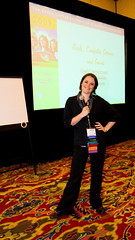
Gail CarmichaelGail Carmichael hit upon the idea of doing a 1 week course on games for girls when her university was soliciting proposals for "enrichment mini courses." These courses are largely attended by grade 8s (~13 year olds), typically the advanced students from the local schools. They're intended to give the students a one-week taste of the university environment. If you are interested in running such a program, Gail suggests that there are often similar programs in other cities, local summer camps, local WISE groups, the Girl Guides/Girl Scouts and many others who could help set something up.

The idea was to do a "head fake" -- get the girls excited about learning games, but manage to teach them computer science topics at the same time. The students seemed to crave the harder stuff, and really were excited about being told things like "they don't learn this until second year university!" once the girls had shown that they understood this difficult concept. Gail suggests that we shouldn't be afraid to give students complex concepts.

She notes that another thing the girls craved is Starbucks coffee... who knew?

When teaching younger students, variety seems to help a lot: Gail incorporates videos, lecture time, small groups, whole class discussions, lab time, and the activities from CS Unplugged.

It's interesting to note that Gail's advice for engaging younger students is very similar to the advice offered during the Best Practices for Introductory Computer Science session, which focused on university-aged students: get the students to work together, use interesting themes to motivate problems, and don't be afraid to give the students hard stuff.

The girls created games using the free tool GameMaker, chosen because it is relatively easy for the girls to make games from the drag-and-drop interface without learning programming. (As someone else who has taught students both with and without this interface, I'll add that for first year students, syntax errors can be a huge stumbling block. Tools like GameMaker allow them to create programs without typos making them frequently feel stupid and inadequate, which is a pretty huge advantage for beginners.) Some other (similar) game-creation tools that might be useful include Alice, Kodu, and Scratch.

So, how successful was it? Gail has run the course twice, and did informal surveys at the beginning and end of the course. Most of the girls thought computer science was a reasonable career for a woman, even before they took the course. This is perhaps not surprising, since they were at least interested enough to sign up for the course. But the real payoff was seeing that the girls really did like computer science more after having had a week to try it out.

Questions during Girls, Computer Science and Games


Gail ended up having the entire hour to herself, since the second speaker, Anne Marie Agnelli, was unable to attend. This gave an opportunity for Gail to showcase one of the games created by her students, as well as have a longer question/discussion section. In fact, the second half of the presentation became much more like a Birds of a Feather session where a variety of women talked about their questions and experiences.

For more notes, including those from the question session, and links to Gail's course materials and slides, see the excellent notes on the girls and games session on the Anita Borg Institute Wiki.

Friday, October 2, 2009

Best Practices for Introductory Computer Science

The panel started with the bad stuff: There were 50% fewer computer science students in 2007 than there were in 2000, with numbers continuing to decline in 2007-2008. The attrition rate is 30-40% in computer science, so we lose a lot of students every year.

Then they moved in to the good stuff: ideas that have worked at their respective universities: Duke, RIT, Union College and the College of New Jersey. There were lots of very specific tips, but I've grouped them into three parts: collaboration, themeing, and hard problems.

Best Practices for Introductory Computer Science Panel


  • Duke has a peer led team learning program, where students can become peer leaders and teach each other.

  • RIT has a game software development introductory sequence, where they teach the first 3 levels of CS as motivated by game design programs.

  • Union college has 5 different theme-based intro courses (plus one for engineers), so rather than working on generic problems in first year, they are immediately working on bioinformatics, game design, etc.

  • The College of New Jersey has a traditional track to level 3, but also accelerated multimedia track. And their CS 3 course has them working on socially relevant, interdisciplinary problems.


There were a variety of themes that came up in all the presentations: collaboration was a big one. Getting students to interact, work together, even teach each other seems to make a huge difference in their ability to learn and succeed. This was done in a variety of ways, from required group projects, teaching, wikis, to more subtle things like requiring use of tools the students may not have seen, so they are forced to learn together, or by teaching games, which tend to be very social. Students still sometimes have to be told "it's ok to talk to each other" but when they do learn to do that, they benefit.

Another theme was, well, themes. Students seemed to respond well to real-world problems, and themes can be used to inspire all assignments, examples, and lessons. Interest in the problems provides motivation for students to overcome the "hard" parts. And "getting it" is a lot more exciting when you're solving a problem that matters -- whether it's making your game work, or writing code that will be used by another department to solve a problem.

And finally, it's clear that in order to get more students to succeed, you don't need to dumb it down. Students are capable of doing very complex things when properly motivated and supported (both by the school and by their peers). In fact, they may be more motivated by hard problems than they would have been by simplified ones, since the hard problems are relevant to real problems. I really loved this part of the discussion, since I myself left computer science (I got a math degree first) because it was too easy and pointless. And I've noticed time and time again, now that I teach first year students, that they're way more capable than outsiders might expect.

I think the panelists summed up their key message well: "Set students up for success -- not failure."

This post can also be found on my personal blog

GHC Bloggers Latest Updates