Showing posts with label security. Show all posts

Friday, October 28, 2011

Keeping up With Facebook for GHC 2011

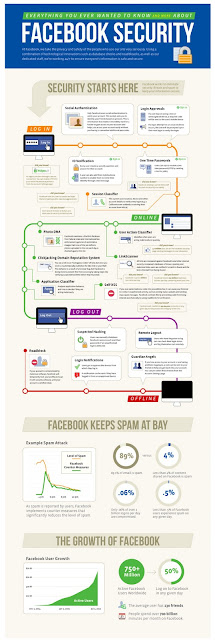
With all of the new features and security options facebook now offers it is difficult to know what your options for staying safe, yet utilizing the social network to its fullest extent. The easiest way to see all of the security features available to you is to check out the info graphic released by facebook below, see the facebook security page for a better view of this graphic.


Which of these security features are important and how can you still be visible professionally while at GHC11? Just remember a few simple guidelines before sharing on our facebook page :
  • Never give your password out to anyone
  • Never post personal or financial information on a wall or discussion, if you need to share this information do it through a direct message
  • Be wary of those with incomplete profiles, on a side note, if you are signing up for a facebook account for GHC11 socializing make sure you complete enough information so that it will be useful to socialize with. More on this in next weeks post.
  • Never make your screen name the same as your email addresses
Do you have some more tips about being safe while social networking on facebook? Post them here in the comments and share.

Until next time!

Charna

Friday, October 2, 2009

GHC09: Susan Landau: Bits and Bytes: Explaining Communications Security (and Insecurity) in Washington and Brussels

Susan Landau started out giving us her history about how she went from a theoretical computer science faculty member at a university to someone working at Sun Microsystems on public policy. A path she said she wasn't working towards, but feel she must've been just a little bit, or she wouldn't have ended up where she is.

The US first started doing wire tapping during the Civil War! Wow! Apparently we didn't slow down - not only did the US use wire tapping to watch criminals, but they were also doing it on congress people and supreme court judges! In particular, a congress person could be talking about the FBI budget and the FBI would be listening in! Clearly a conflict of interest!

Congress didn't like this and put in a law to regulate this - requiring wire taps to only be for a specific person at a specific number

In 1994 a US law was passed that required all digitally switched telephones to be built wire tapped enabled! The equipment was to be designed by the FBI, much to the chagrin of telephony providers.

This is problematic - in 2004-2005, it was discovered that some non US diplomats had been wiretapped - but not by a government entity! (at least not officially.) This was discovered when there was some problems with text messaging on one of these phones. They found the switch in Greece, which had been bought from a US company with the wire tapping software disabled - so no auditing software was enabled. Someone very knowledgeable with the switch used a rootkit to get in, turn on the wire tapping software and then targeted these diplomats! With no auditing software enabled, the Greek phone company had no idea this was happening until there were problems with the text messages! Once this illegal wire tap was discovered, the phones that were listening in suddenly went dark and the perpetrators were never found. Very scary stuff!

This is a clear example of how software made to "protect" us can actually be used to spy on innocent people - terrifying indeed!

All of this gets much more complicated with technology like VoIP (Voice over Internet Protocol) where people do not have a set phone number, it is done with the IP address which will vary every time you reconnect your laptop or mobile device to the network. What this means is it is very hard to pinpoint the caller - one of the risks here is that the wrong person will be eavesdropped upon.

Landau knows it is very important for society to have secure communications - to enable conversations with first responders, for example, and we need to have the technology to do this.

Landau continues on about how much more devastating natural disasters are than terrorist attacks, yet for some reason they don't get nearly as much news and political coverage than a terrorist attack. I wonder if we all feel we're more protected from a random natural disaster? Or if we are fascinated with how evil someone would have to be to purposefully hurt another human? hrm.

President Bush apparently authorized warrantless wire tapping in 2001 - and this was relatively unknown and undiscovered until 2007. She wrote an op-ed for the Washington Post on this topic, and next thing she knew, she was the expert on privacy. This is good, in that she now has Washington's ears, but she realized she needed to find more people to help support her in this and she was happy to find many intelligent, bright and like minded folks.

Now she's been working on reviewing public policy - basically doing law reviews. Landau jokes that she feels she's in training to be a lawyer.

If you want to get into public policy, you need to learn their stuff: "laws, policies, motives", to speak well, write well and have great courage. She believes these are all the traits that a good engineer should have as well, so perhaps it's a career path after all. :-)

Valerie Fenwick

Wednesday, September 30, 2009

Grace Hopper: PhD Forum 4

Sitting in my second packed room of the conference! Considering we're still before "official" launch time, I can't believe how many women are here and how packed every session is! Here in my first session in the PhD series, I'm excited to see three PhD students present their research.

An n-gram Based Approach to the Classification of Web Pages by Genre: Jane E Mason, Dalhousie University:

Mason is looking for a novel approach to doing classification of web sites by actual genre - not just keywords. For example, searching for a health condition and only showing you information pages instead of pages by drug manufacturers attempting to sell you something.

Mason chose to use n-grams, because they are relatively insensitive to spelling errors, are language independent, and relatively easy to program. She combines these and then processes them with the Keselj Distance Function, which is apparently "simple", but it has been awhile since I've been in Differential Equations :-)

Mason and her team have been looking at how to let some web pages have multiple genres, which means that some pages end up with no genre - noise! While it's easy for a human to identify a nonsense/useless web page, I think it's pretty cool to get a computer to do this for you, so you won't even see it in the search results!

Ant Colony Optimization: Theory, Algorithms and Applications: Sameena Shah, Institute of Technology Delhi:

I've never heard of this type of optimization, so this was very interesting for me. Shah chose to study this area of optimization because ants don't have centralized coordination and they make great decisions based only on local information. She sees this as a great method to apply to distributed computing. Now, how do we get computers to leave pheromones on the path of least resistance?

Other than the lack of pheromones, another problem she had to solve is that ants don't always find the shortest path - if enough ants have taken a longer path before the short path is discovered, all of the ants in the colony will use the longer path and ignore the short path. Obviously, she doesn't want that short coming in her algorithm :-)

Shah does have a slide in her presentation which shows the statistical "solution", but it's a much more complicated formula than I ever saw in my intro to statistics course at Purdue. :)

Using Layout Information to Enhance Security on the Web: Terri Oda, Carleton University:

Ms Oda is a woman after my own heart, starting her presentation with a xkcd comic :-)

She starts her talk out talking about different types of security, like secure networks between companies. Oda tells us about how the threat models are no longer obvious: those seemingly innocuous applications in facebook that have access to your private chats on the site and private emails, websites that don't properly protect passwords, and malicious users on the same forums. Her talk moved onto the types of threats she's actually trying to protect you against: cross-site scripting and previously good sites that have gone bad.

She makes an excellent point that most (all?) web pages are done by web designers (aka artists), NOT web security experts and with all their deadlines and basic functionality bugs, there is no time to even think about security. Is it any wonder we have so many attacks and vulnerabilities out there?

but how can we solve this? Schedules will never have enough padding and most people designing web sites did not receive a BS degree from Purdue (where we were told over & over again that security must be designed in from the beginning, not as an add-on)

She's looking at using heuristics to correctly identify different elements on a page so that it's visually evident which components on the page are from the site you're visiting or being served from an external site (like an ad). I can't wait to see how her research turns out, and how much she can protect the user with a simple browser add-on!

Valerie Fenwick

GHC Bloggers Latest Updates